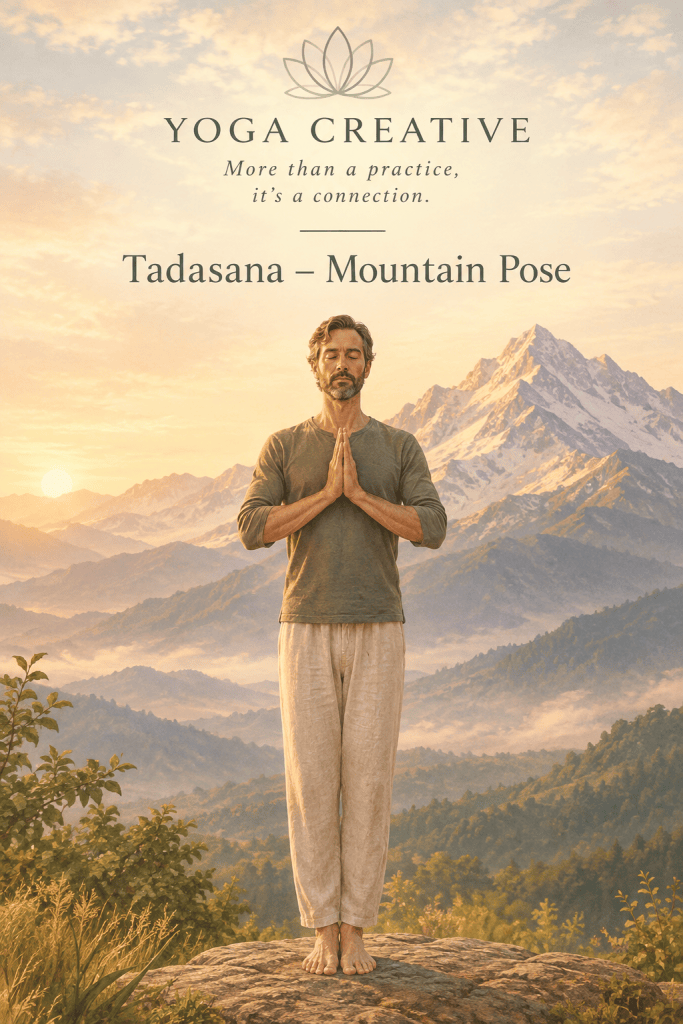
What comes to mind when you think about the asana (pose) Tadasana? I imagined words such as: standing, waiting, let’s get moving, etc … When I first started practicing yoga I didn’t understand the need to have a name for simply standing. I soon learned there was much more to be gained from the simple act of “standing”.
The Sanskrit word “Tadasana” means “Mountain Pose”. Mountains are tall, permanent, strong and steady. What we practice on our yoga mats informs us how and who we are when we are off our mats. Practicing Tadasana teaches us how to embody the strength, permanence and majesty of a mountain.
Tadasana is not a passive pose. It’s the active foundation for all standing poses. In this pose we first learn proper posture but more importantly, Tadasana offers an opportunity to really start to connect with what our body is experiencing. Beginning your practice with Tadasana/Mountain allows us the opportunity to very singularly listen to what your body is telling you. You can intensify this experience by closing your eyes.
When you close your eyes in this or any asana, your other senses have an opportunity to take the lead. Your mind can let go of visual distractions and tune in to the sensation of your feet, leg muscles, joints and the tingle of the mid-back. Your fingers feel the air, your neck settles into place as it supports your head.
Tadasana is a place of intention which affords you the opportunity to examine why you are going to practice yoga.
To practice Tadasana:
- Stand with your feet together. Look at your feet and see them firmly planted beneath you.
- Rock forward and back, then side to side, and notice all four corners of your feet as they sink into the floor.
- Here is where you set your “drishti,” or focused gaze. Let your eyes settle on a fixed point on the horizon ahead of you. Try to find something that won’t move.
- Now, stack your knees over your feet and your hips over your knees.
- Firm your abdominal muscles to engage your core.
- Relax your shoulders down and back. Lengthen your spine as if you were creating more space between the vertebrae.
- As your feet remain firmly planted on the floor, imagine extending the crown of your head toward the ceiling.
- Close your eyes and breathe. As you stand in the pose, take this opportunity to really tune into what you are experiencing, both physically and emotionally. Adjust as you need to. You may notice that you are gently swaying. This is natural, and your body will naturally self-correct. Stay in Tadasana for at least five breaths.
Then, open your eyes and begin your practice.

Leave a comment